 Historiography and Monetary Consciousness in Plantagenet England
Gabriele Passabì
+44 020 7309 2041 g.passabi@ghil.ac.uk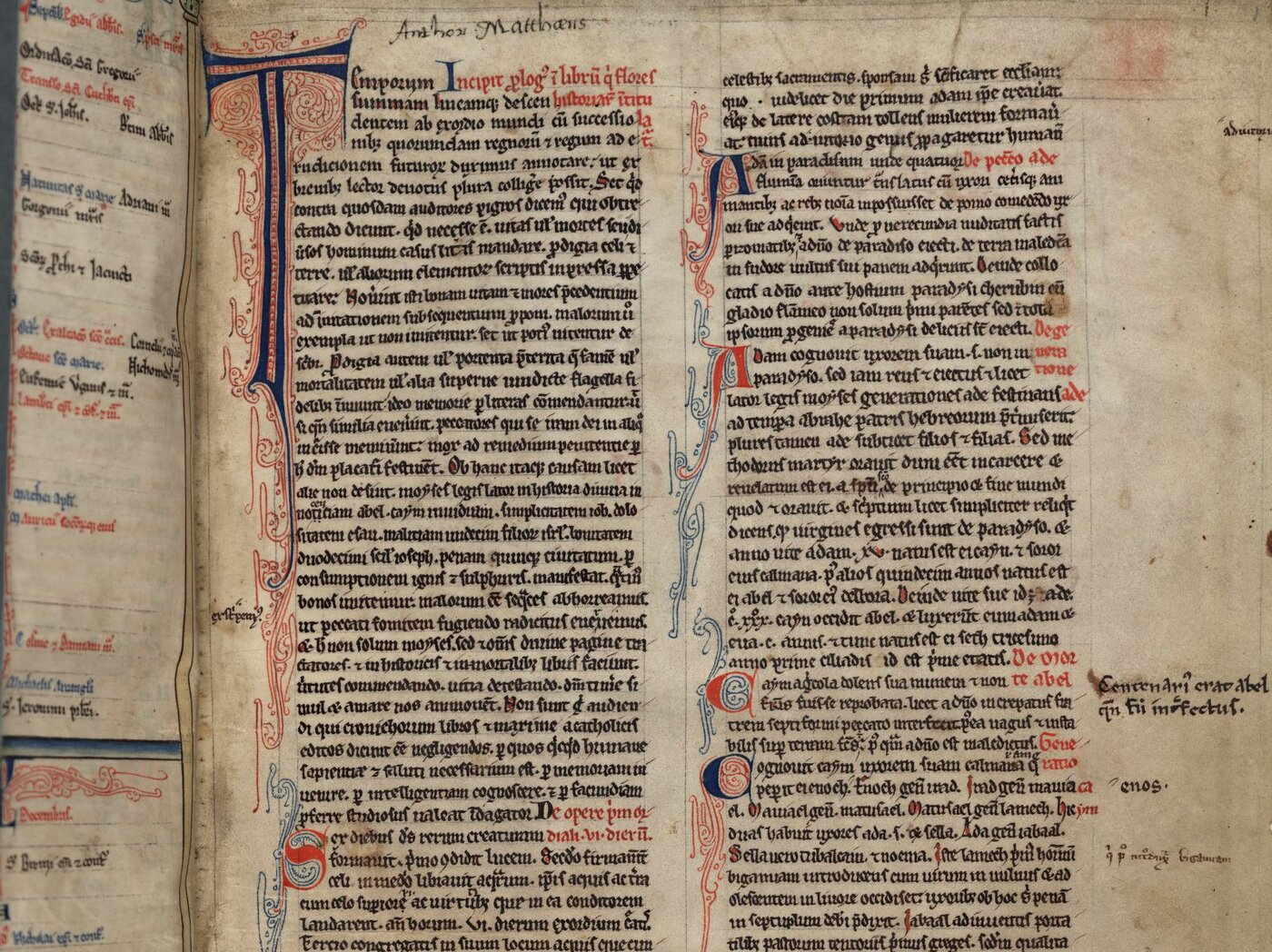
At the GHIL, I will contribute to Marcus Meer’s project ‘Money, History, and Moral Economies: Communicative Functions of Monetary Information in the Institutional Historiography of the Later Middle Ages (1250–1530)’. My research will explore the communicative role of monetary information in English historiography in the central and late Middle Ages.
Historiography served as a powerful medium for shaping collective memory, political expectations, normative frameworks, and institutional identity. However, references to monetary phenomena in historiographical texts, such as prices, taxes, debts, currency, and value have rarely been studied in relation to the broader purposes and intellectual frameworks of historical writing. Rather than treating such references as residues of administrative practice, the project approaches them as communicative strategies whose logic is inseparable from the writing practices and intellectual rationale of medieval historiography.
Medieval England offers an ideal context for examining how historical writing engaged with economic change. England’s integration into north-western European trade and the growth of royal administration reshaped institutional structures and economic life. At the same time, a rich historiographical tradition developed alongside these profound transformations in commercial life, governance, and political culture. Chronicles, whether produced in courtly circles or as expressions of local monastic institutions, reflected and interpreted these changes. My project explores this dynamic through the lens of monastic institutional historiography in the Plantagenet period.
A case in point is the universal history tradition at St Albans, one of the longest-running institutional historiographical traditions in medieval England, including chroniclers of the calibre of Matthew Paris (d. 1259) and Thomas Walsingham (d. 1422). More than a local chronicle, the St Alban’s tradition was a sophisticated historiographical project that engaged critically with the political agency of the Plantagenet kings and situated English affairs within a wider European—and at times global—frame. Crucially, St Albans chroniclers worked within the intellectual architecture of universal history, a framework that sought to locate the actions of kings, religious institutions, and communities within a providential narrative. This universalising perspective offered a powerful evaluative lens through which political behaviour, institutional conduct, and, crucially, economic practice could be judged. Rather than understanding monetary information simply as reflective of contemporary material pressures, my research will tackle them as part of narrative strategies embedded in the evaluative framework of the historiographical discourse.
Methodologically, the project combines close textual analysis with systematic mapping of monetary references across the St Albans corpus and comparison with other contemporary institutional chronicles. Prices, taxation, coinage, value, and other monetary phenomena will be catalogued and analysed in relation to their narrative context, rhetorical function, and moral evaluation and set against broader developments in commercialisation, monetisation, and fiscal administration. The project argues that the expanding economic life of thirteenth- and fourteenth-century England became a crucial arena in which chroniclers negotiated institutional religious identity and articulated competing visions of ecclesiastical governance and kingship. Monetary rhetoric emerges as a deliberate medium for expressing normative claims about authority and social order.
Within the wider comparative framework of the DFG-funded project, my research contributes to studying how monetary language varied across institutional and regional contexts and how it functioned as a shared communicative practice. By uncovering the rhetorical and conceptual work performed by monetary discourse in the chronicles of Plantagenet England, the project repositions historiography as an active participant in medieval economic thought and in the cultural interpretation of an increasingly monetised world.