 Ole Münch
Ole Münch is a cultural historian and historical anthropologist specialising in modern Britain, with a strong background in social theory. He is particularly interested in the dynamics of intercultural contact—not only across ethnic and religious divides, but also across class boundaries. From this vantage point, he now explores the history of social research.
Ole studied History and Sociology in Göttingen, where he developed a keen interest in the emerging urban ways of life in Victorian Britain and where he explored the theoretical debates surrounding the Cultural Turn. For his PhD, he moved to the University of Konstanz to work at a ‘Centre of Excellence’ alongside researchers from different disciplines, collectively exploring the dynamics of intercultural contact and integration. In this stimulating environment, he wrote his award-winning dissertation on the Rag Fair street market in early Victorian London—a place where migrants of diverse origins and religions met and mingled. An English translation was published in 2025 by Berghahn.
Ole has published not only on the street traders of Victorian London, but also on the middle-class social explorers who wrote about them. When analysing the ‘making’ of social knowledge, he seeks to move beyond a top-down perspective, viewing social exploration and research as a complex interaction between researchers and study subjects, who perceive and influence each other in sometimes unforeseen ways. In this vein, his current project focuses on sociological traditions in interwar Britain and America, and on members of the growing white-collar middle classes who read and appropriated ‘elite’ social knowledge to make sense of themselves and their own life worlds. Ole joined the GHIL in August 2021.
Research Project
Learning to be an Outsider
On the Rise of Social Scientific Self-Awareness in Interwar America and Britain
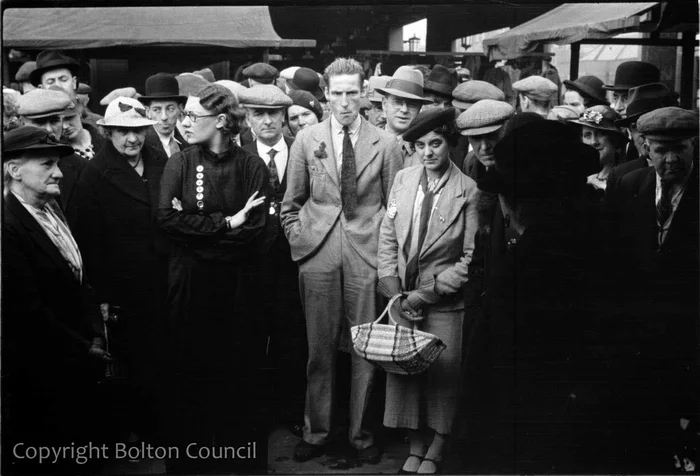
Contemporary society, so a common narrative holds, is shaped by an educated ‘new middle class’ (Reckwitz) that values personal autonomy and individual uniqueness. The emergence of this class in the 1970s was fuelled in part by the academic ‘cultural turn’, which foregrounded questions of identity and subjective experience.
My project traces the (entangled) history of two interwar social research movements that anticipated this turn: the Chicago School of Sociology (1915–1935) and the British lay sociological project Mass Observation (1937–1949). Notably, both movements gained popularity beyond the academic elite and inspired people to describe themselves in new, quasi-sociological terms. By comparing these self-narratives in Britain and the United States, my project explores what they reveal about the rise and ‘sprawl’ of a middle-class individualistic ethos.
Responsibilities at the GHIL
- Research Fellow in British History of the 19th and 20th Century
- Convener of the GHIL lecture series
Research Interests
- Migration History
- History from Below
- Micro History
- Social Theory
- History of Knowledge
Education and Academic Background
| 2021– | Research Fellow at the GHIL |
| 2013–2019 | Ph.D, University of Constance |
| 2013–2017 | Research Fellow at the Cluster of Excellence 16 »Cultural Foundations of Social Integration«, University of Constance |
| 2004–2007 | Research Assistant at the chair of Prof. Dr. Rebekka Habermas, Georg August University, Göttingen |
| 2003–2011 | Master in Sociology and Medieval and Modern History at the Georg August University, Göttingen |
Fellowships, Grants, and Scholarships
| Aug 2017 – Dec 2017 | Ph.D Stipend of the Baden-Wuerttembergian Graduate Scholarship Programme |
| Dec 2015 – Jan 2016 | Ph.D Research Stipend of the German Historical Institute, London |
Honours and Distinctions
| Dec. 2020 | Dissertation Prize of the City of Constance for the Promotion of Young Scholars at the University of Constance |
| Nov. 2020 | Wolfgang J. Mommsen Dissertation Prize of the German Historical Institute London |
Memberships and Affiliations
- Member of the British Association of Victorian Studies
- Member of the London Literary Society
Publications
Monographs and Edited Volumes
Rag Fair. A Different Migration History of London’s East End, Studies in British and Imperial history 10, (New York/Oxford, 2025) [translation of the below]
Cutler Street Market. Interkultureller Austausch im Londoner East End 1780–1850, Moderne Zeit 33, (Göttingen, 2022)
Articles and Chapters
‘The Romance of Rationality. Performing an Economic Identity in the Mean Streets of Early Victorian London’, in Esther Schomacher, Jan Söffner (eds): The Culture of Money: Implications for Contemporary Economic Theory (Economics and Humanities) (London 2025 [autumn 2024]), 136-156
‘Amateur Sociology as an Escape from Domestic Gloom. Re-Analyzing an Oral History Interview with Former Mass Observation Member Celia Fremlin’, in Sofie Steinberger, Lena Rüßing and Gerda Kuiper (eds.), Combining Historical and Ethnographic Methods: Theoretical, Methodological, and Ethical Implications (Kölner Arbeitspapiere zur Ethnologie, 9) (Köln 2024), 56-66 (Read here)
‘Integration auf dem Altkleidermarkt. Die Cutler Street des Londoner East Ends im 19. Jahrhundert’, in Jüdische Geschichte & Kultur. Magazin des Dubnow Instituts, 7/2023 (2024), 24-27
‘Risky Business at Rag Fair. On Interreligious Relations in the Mean Streets of Early Victorian London’, Immigrants and Minorities Journal, 37/1 (2019), 1–23
‘Die Absetzung Richards II. von England (1399) als mitreißende Massenveranstaltung. Oder: Der heilige Körper des Königs und der Versuch ihn zu überwinden – ritualtheoretische Überlegungen’, in Robert Gugutzer/Michael Staack (eds), Körper und Ritual. Sozial- und kulturwissenschaftliche Zugänge und Analysen (Wiesbaden 2015), 219–244
‘Henry Mayhew und die Straßenhändler des viktorianischen London: Ein kultureller Austausch mit sozialen Folgen’, WerkstattGeschichte 22/63 (2013), 83–99
- English translation in: London Journal 43/1 (2018), 53–71
‘Zerstört Geld soziale Beziehungen? Ein sozialtheoretischer Essay’, Kritische Ausgabe 15/23 (2012), 29–33
Reviews and Miscellaneous Publications
Reviews
Laura Carter, Histories of Everyday Life: The Making of Popular Social History in Britain, 1918–1979 (Oxford, 2024), Historische Zeitschrift, 321/2 (2025), 520-522 (Read here)
Sudhir Venkatesh, Off the Books: The Under-ground Economy of the Urban Poor, Cambridge, MA 2009, WERKSTATTGESCHICHTE 88, Jg. 2023/2, 135-139 (Read here)
Victoria Kelley, Cheap Street. London's Street Markets and the Cultures of Informality, c.1850–1939, Manchester 2019, H-Soz-u-Kult, 30 September 2022 (Read here)
Blog contributions:
‘Soziologische Objektivität als Lebensform – ein Fallbeispiel’, in Themenportal der Max Weber-Stiftung, 2023 (Read here)
'Cutler Street Market. Interkultureller Austausch im Londoner East End', [gab_log] Geisteswissenschaften als Beruf/readme.txt, 4 January 2023 (Read here)
‘A Spurious Abortion of an Impure Brain’: What did the London Street Traders think about Henry Mayhew?, The Victorianist: BAVS Postgraduates Blog, 3 October 2019 (Read here)
Multireligiosity as a Rallying Call: The Petticoat Lane Street Market in the 1850s, Global Urban History Blog, 17 April 2019 (Read here)
Other publications
with Indra Sengupta: ‘Interview von Stefanie Hardick: Der Blick über den Rand der Archive’, in Weltweit vor Ort. Das Magazin der Max Weber Stiftung, 2026/1 (2026), 12–15 [Read here]